
Nassau County Previous Residents Sources
Previous residents of a Nassau County address leave different kinds of dated evidence. The assessment parcel provides a present-day starting point. A deed trail follows ownership or a recorded interest. A reverse directory can place an occupant by street and number. Census schedules show a household in a historical geography, while municipal files and maps can explain changes to the structure or lot. Start with the source closest to the year in question, then use a second source to test whether the address and people line up.
| Source | Nassau County period | Where it is held | What it can show |
|---|---|---|---|
| Deed and legal record | Registry 1899+; historic repository 1840-1982; current images 1994+ | County Clerk portals, document room, land-record room | Recorded parties, dates, book or page, and legal description |
| Criss-cross directories | 1972-2007 | Library of Congress | Address-to-occupant entries for a volume year |
| Nassau directory leads | 1868-1869 and 1909-1913; local runs require verification | LISI, libraries, and catalog leads | Printed household and address context |
| Federal and state census | Federal releases through 1950; state series 1825-1925 | Libraries, archives, and Family History Centers | Historical household and geography details |
| Map or permit file | Period and municipality vary | LOC maps; city, town, or village custodian | Building, road, subdivision, or project context |
Nassau County has no single continuous address-history index. The Clerk, library, municipal counter, archive, and courthouse terminal are all part of the fallback chain. A missing online result may mean an older book, microfilm, a different portal, or an offsite file rather than an empty history.
Save a Nassau County Parcel Baseline
Before looking for past residents, save the current Nassau County parcel information from the Land Records Viewer. Record the situs address, municipality, Section, Block, Lot, legal reference, and any recent-sale or liber and page information. The situs is the physical parcel. A mailing address belongs to assessment correspondence and may point somewhere else, so it is not proof of occupancy at the Nassau County address.
The SBL is the key bridge. It helps distinguish two similar road names, a changed street number, and lots that were later joined or divided. Check the GIS parcel geometry as well. If the property is a condominium or has a metes-and-bounds description, the recorded legal description may be more exact than the street address used in a directory.
Note: Preserve the address exactly as printed in each source, including abbreviations, because a historic index may not match a modern street format.
Nassau County Previous Residents Deed Trail
The deed chain is the backbone for prior ownership, not a complete list of past residents. Begin with the current owner or recorded party connected to the saved Nassau County parcel. Find that person's purchase deed, read the seller, and search the seller as a grantee in an earlier period. At each turn, compare the legal description, lot, subdivision, SBL, and book or page. A match on name alone is too weak for a backward address trail.
- Use the LRV parcel to save the current SBL and legal description, then note any recording reference shown with a recent sale.
- Search the current recorded owner as grantee in the County Clerk index and locate the purchase instrument.
- Read the grantor, recording date, instrument reference, and prior legal description. The grantor is the party transferring an interest; the grantee is the party receiving it.
- Search that earlier party as grantee in the prior date range, and confirm the same lot, subdivision, or legal description before continuing.
- When the online search changes era, use the historic repository, document room, land-record room, books, or microfilm instead of assuming the Nassau County chain has ended.
- Grantor and grantee
- The grantor transfers a recorded interest; the grantee receives that interest in the instrument.
- Chain of title
- The sequence of recorded transfers or interests tied to the same land.
- Legal description
- The recorded land identity, often more precise than the street number for an older search.
- Criss-cross directory
- An address-arranged directory that can provide a dated occupant clue for one street number.
Nassau County Clerk Index Eras
Nassau County previous residents research often crosses several record formats. Nassau was created in 1899, and the County Clerk's land registry begins then. The historic Official Records repository advertises official-record material from 1840 through 1982, while the county's electronic property database began around July 1992 and current online document images begin February 22, 1994. Those dates describe access layers, not a promise that every record appears in one search screen.
The Clerk's format history explains the handoff: tan books cover 1899 to 1967, microfiche 1967 to 1987, blue books 1987 to 1994, and microfilm from 1994 onward. Search the historic Nassau County Official Records repository by direct or reverse index, deed records, record type, book number, or year range. The current Official Records system is the later interface. OCR can miss handwriting and older scans, so name variants and book references matter.
The historic repository displays the direct, reverse, deed, plat, and OCR paths that support an address trail.
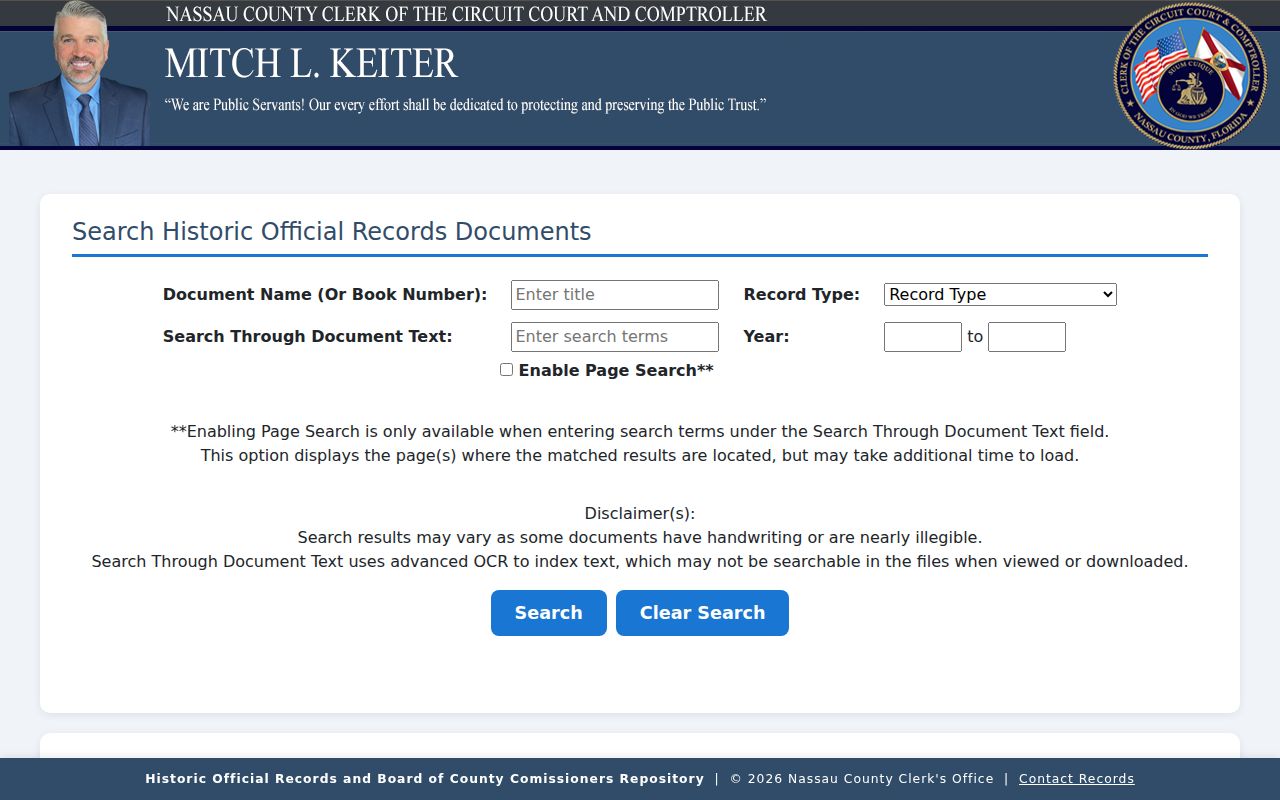
The image illustrates why a past-resident search may require a direct or reverse index rather than an address-only query. For intermediate eras, ask the Clerk's document room or land-record room about books and microfilm.
Nassau County Past Residents Checkpoints
Ownership is only one part of a Nassau County address history. For a household-level clue, look for the address in a criss-cross directory, telephone volume, or local directory near the date of a transfer. The Library of Congress inventory lists Nassau criss-cross volumes from 1972 through 2007. Each listing must be read as evidence for that particular volume year. A no-listing result can reflect a gap, a changed community label, an alternate householder name, or the way the volume was indexed.
Historical directory collections are not all online and no continuous Nassau County run has been verified. Nassau Library System member libraries hold local materials branch by branch, while Hofstra University's Long Island Studies Institute has books, newspapers, maps, photographs, census material, genealogies, government documents, manuscripts, and audiovisual records. LISI is open weekdays from 9:00 to 4:45; Special Collections need an appointment and prior approval for non-Hofstra visitors.
The Nassau County Directory Book identifies the collection leads and access distinctions. Bring the address, municipality, surname variants, and a short year range to a library or archive request.
Nassau County Census Pairing Method
Pair a directory year with the closest released census, then look for agreement instead of forcing a match. Federal schedules are released under a 72-year rule, and 1950 is the most recent public decennial schedule. New York State census years useful for Nassau County include 1825, 1835, 1845, 1855, 1865, 1875, 1892, 1905, 1915, and 1925. State access is divided among the State Library, Archives, microfilm, and Family History Centers.
- Write down the address form and the exact year of the Nassau County directory or criss-cross entry.
- Find the closest federal or state census release and identify the town, village, or community geography used that year.
- Compare the household names, ages, birthplaces, and address context with the directory, without treating either source as complete by itself.
- Use a deed, newspaper notice, map, probate file, or vital record to test a transition into or out of the address.
Census geography must be read against Nassau County's changing town and village labels. It is historical context, not a replacement for the parcel or deed record.
Nassau County Sanborn and Permit Clues
Maps can bridge an address change without pretending to name every occupant. Library of Congress Sanborn sets provide Nassau County snapshots for Glen Cove in 1908 and 1915, Inwood in 1909 with revisions through January 1950, and Long Beach in 1922 republished in 1955. They show building footprints, construction or use clues, street names, and nearby structures. The Nassau GIS viewer's 1926 and 1950 map layers can be compared with the current parcel and road geometry.
For a building event, contact the city, town, or village that holds the permit or code record. There is no universal countywide permit portal. North Hempstead requires FOIL and a records-room appointment for prior-owner permit files. The Nassau County Health Department's realty or sewage route can also use SBL, street, community, subdivision, and approval information to locate a narrow address file.
Close Nassau County Address Trails
An obituary, probate file, cemetery entry, or newspaper notice can help close a Nassau County past-residents trail after a person leaves the address or dies. Read the publication date, funeral provider, cemetery, surviving family, former community, and service references, then verify them with another record. Nassau newspaper holdings at the State Library have title-specific microfilm and service-copy periods, so use the paper that fits the community and date rather than a broad modern search.
Nassau Surrogate's Court holds probate and estate filings at 262 Old Country Road in Mineola. WebSurrogate covers filings on or after February 19, 2014; older searches require courthouse public computers. A probate record can identify a fiduciary or heir, but an address in an estate file is historical evidence and may have limits or redactions. The Records Management Center also holds millions of inactive files from 54 agencies, and certain pre-1999 court files can need three to five business days for retrieval.
Note: Cite each document, volume, page, map sheet, or case reference so a later reader can separate a solid address link from an untested lead.
Nassau County Previous Residents Boundaries
Previous residents research in Nassau County has limits. A deed does not identify every person at an address. A directory entry is tied to its printed year. Census addresses can use an older geography. The Clerk cannot give legal advice or determine ownership by phone. Private records, sealed proceedings, adoption information, confidential voter records, and DMV information remain outside a normal address trail.
Use this record path for family history, a property's past, estate questions, or personal historical research. Do not try to work around a protected address by combining unrelated records. When a result matters, verify it with the Nassau County custodian and preserve the date, source, and parcel connection.