
Nassau County City Directory Collections
Nassau County does not have one uninterrupted, countywide run of digitized printed collections. The strongest starting points are the community library that served the address, Hofstra University’s Long Island Studies Institute, the New York State Library, and the Library of Congress. Each keeper describes a different type of access. A catalog entry may identify a title while the book itself remains noncirculating, on microfilm, or available only in person. Confirm the title page, community coverage, and year before treating a result as a historical volume for a particular household.
| Collection lead | Years or scope | Where held | How to use it |
|---|---|---|---|
| Nassau directory mentions | 1868-1869 and 1909-1913 leads | LISI, NYG&B, and library leads | Confirm title and publisher onsite |
| Hempstead directory leads | 1901/02, 1903/04, 1915/16, 1930/31 | NYSL, FamilySearch, or branch holdings | Access varies by volume |
| Telephone and householder volumes | Nassau 1913-1975; community sub-runs | Libraries and archives | Check microfilm or shelf access |
| Criss-cross directories | Nassau County 1972-2007 | Library of Congress | Request or use in person by address |
The New York State Library directory guide covers city, county, and telephone directories in noncirculating microform. Its collection is a search route, not proof that every Nassau County community has a separate volume. The Library of Congress likewise notes coverage gaps and nearby-community overlap. Volume-level checking prevents a familiar community name from being assigned to the wrong town or village.
Note: A catalog hit establishes a collection lead, while the printed title page establishes what places and dates a volume actually covers.
Nassau County Directory Shelves
The Nassau Library System connects 54 independent member libraries, and local-history material is often at the branch closest to the community rather than at a single county desk. Ask staff for historical directories, reverse or criss-cross books, telephone books, yearbooks, local newspaper microfilm, funeral notices, vertical files, and licensed genealogy databases. The system’s central contact route does not perform obituary searches, so a specific branch or co-central library is the practical fallback for a name and date.
Hofstra’s Long Island Studies Institute is the regional fallback when a branch shelf stops. Its public material includes books, newspapers, maps, photographs, census material, genealogies, government documents, manuscripts, and audiovisual records. LISI is in Axinn Library Room 032, is open weekdays from 9:00 to 4:45, and can be reached at 516-463-6411. Special Collections are appointment-only, and visitors who are not affiliated with Hofstra should get prior approval.
- Bring the exact address, community label, and spelling variants.
- Ask whether a volume is street order, name order, or both.
- Record the title, year, publisher, page, and abbreviation key.
For a former classmate or a family connection, a yearbook, alumni collection, or period newspaper can be a safer historical clue than treating an old directory listing as a present address. Nassau County labels such as Great Neck, Hempstead, Garden City, Port Washington, and Long Beach can appear as postal or community names even when the record’s legal town or village field differs.
Nassau County Historical Directory Sources
The Nassau County Historical Society provides another collection-level route for Nassau County family and civic research. It was organized in 1915, incorporated in 1920, and received a permanent charter in 1958. Its holdings include artifacts, documents, books, writings, programs, and a journal. The volunteer-run society says it does not perform genealogical research requests, so ask about collection scope or access rather than expecting a staff search of a surname.
The Historical Society’s collection and contact surface is shown below. It is useful for locating the right Nassau County context, not for treating an organizational reference as a directory entry.
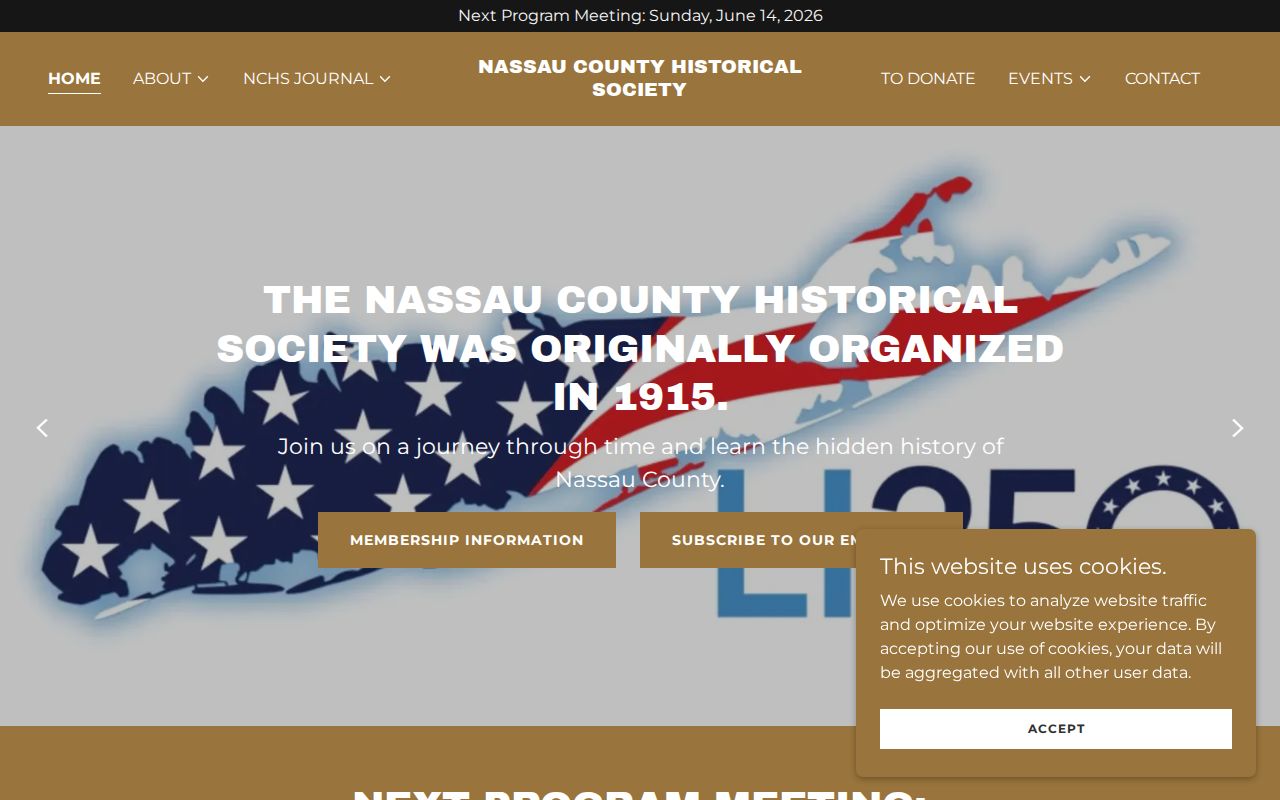
Society material can support a date, place, institution, or streetscape clue after the relevant directory volume has been cited. The contact address is PO Box 207, Garden City, NY 11530-0207, and the listed phone is 516-538-7679.
- 1915: the Nassau County Historical Society was organized.
- 1920: the organization was incorporated.
- 1958: it received a permanent charter.
Read Nassau County City Directory Entries
A printed Nassau County city directory entry should be transcribed rather than modernized. Capture the name as printed, any spouse or household notation, the house number and street, community or post office, business or affiliation line, directory year, page, publisher, and the book’s abbreviation key. An entry often helps connect a name to an address, but it does not prove present occupancy or explain every person in a household.
| Name line | Keep initials, punctuation, and spelling exactly as printed. |
|---|---|
| Household notation | Parentheses or other marks may identify a spouse or relationship clue. |
| Address | Copy house number, street, community label, and page reference. |
| Affiliation line | Record an occupation, business, or institution only as the volume prints it. |
| Volume key | Use the title page and abbreviation key before expanding any mark. |
- Criss-cross directory
- A reverse directory arranged by street and house number, useful when an address is known before a name.
- Householder index
- A name-oriented list that may identify the person the publisher treated as the household contact.
- Abbreviation key
- The book’s explanation of its own shorthand, usually near the front matter and more reliable than a modern guess.
Do not expand a widow, boarder, street, avenue, telephone, or occupancy abbreviation unless that volume’s key supports it. A blank name or no listing is not proof that a building was vacant.
Nassau County Criss-Cross Directories
Later Nassau County criss-cross volumes offer the historical address-to-occupant view that an ordinary city directory may not. The Library of Congress inventory identifies Nassau County coverage from 1972 through 2007. Those books are arranged by street and house number, so an old address can lead to a printed occupant listing even when a name search fails. Library of Congress access is onsite or by request, and each volume must be checked for its actual scope.
Use the exact street spelling from the directory, then compare it with the parcel’s Section/Block/Lot and current legal description. An address may have changed format, belong to a condominium or subdivision, or carry a postal name different from the municipality. For current address-keyed evidence, use the Nassau County street directory route rather than extending a historical listing past its date.
Note: A reverse listing names an occupant in a particular edition and does not establish ownership, household membership, or a later residence.
Nassau County Newspapers by Era
When an older printed volume skips a year or a household disappears, use a period-appropriate newspaper rather than a broad web search. The New York State Library lists Nassau titles with different runs and service-copy dates, including the Hempstead Inquirer from 1859 to 1920, the Hempstead Sentinel from 1899 to 1949, the Nassau County Gazette of Mineola from 1898 to 1926, and the Newsday Nassau edition from 1940 onward in its catalog range. Availability depends on microfilm and service copies.
An obituary can add a death date, surviving relatives, former community, funeral home, cemetery, or service reference. It remains historical evidence, not a current address record. Pair the notice with a vital-record route, probate file, cemetery record, or Nassau County directory entry before attributing a household change to the right person.
The New York State Library’s Nassau newspaper holdings make the title-by-title difference visible. Search the newspaper tied to the community and period, then save the title, issue date, page, and image or microfilm citation.
Trace Nassau County City Directory Families
Follow a Nassau County city directory household across nearby editions, not by assuming the collection is annual or complete. A move, death, changed post-office name, spouse listing, business listing, or skipped publication can all make a name appear to vanish. The aim is a dated sequence of printed evidence, with each address and spelling preserved for the next record search.
- Locate the first confirmed name or address and record the volume’s title-page details.
- Check nearby editions for the same spelling and for maiden, married, initial, Mc/Mac, apostrophe, and hyphen variants.
- Use the reverse section, where present, to test the printed address and nearby listings.
- Pair directory dates with the 1900-1950 federal census releases and New York’s 1915 or 1925 state census.
- Close a trail with a newspaper notice, Surrogate’s Court file, cemetery record, deed, or vital-record route.
The federal census is released after 72 years, and the New York State Library directs researchers to state holdings, microfilm, Archives, and Family History Centers for state census material. A census and a directory should corroborate one another, not be treated as interchangeable. Census geography must also be read against Nassau County town and village boundaries for that year.
Nassau County Directory Microform
The New York State Library city-directory collection is an important Nassau County fallback because it includes city, county, and telephone directories in noncirculating microform. Search by title and locality. Do not assume a digital scan exists, and do not assume a Nassau County place name has a separate catalog entry. The State Library page shown below explains the collection’s onsite orientation.
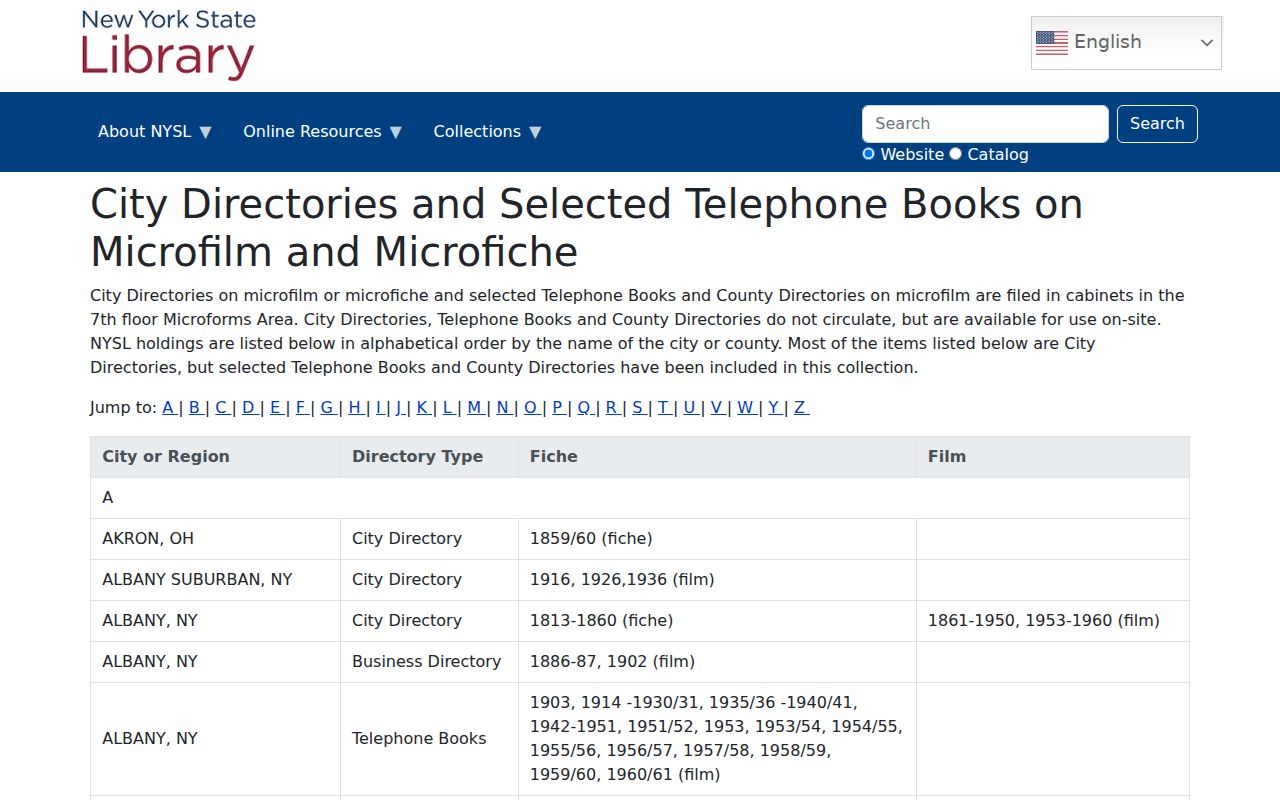
Microform access can supply a directory year that a local web catalog does not surface. Write down the reel or volume identifier alongside the page citation, then use the title page to confirm the publisher, territory, and edition date.
Nassau County Address Context
Historical images and maps explain a place without proving who lived there. The Nassau County Photo Archives Center at Old Bethpage holds more than 100,000 prints, negatives, postcards, and slides from roughly the 1870s through the 1970s. It offers onsite viewing, research, and copying. Keep the caption, date, photographer or collection, and location with any image used as evidence.
Nassau County’s 1926 and 1950 GIS layers, together with Library of Congress Sanborn sheets for Glen Cove and Inwood, can bridge a changed road label, subdivision, or streetscape. For coastal research, Long Beach map sheets also cover Island Park, Atlantic Beach, Lido Beach, Point Lookout, and part of Hempstead. Compare the map, directory address, and municipality before deciding two labels identify the same location.
Note: A photograph or map confirms historical context, while a dated directory, parcel, deed, or census source is needed for a person-level conclusion.