
Nassau County Resident Lookup Records
No Nassau County resident lookup produces a complete list of current residents. Official sources each answer a narrower question. An assessment record can identify a parcel and recorded owner information, a deed connects a party to a dated instrument, a court index describes a case, and a vital record documents an event. Begin with the source that matches the question, then compare independent details before associating a record with a particular person.
| Record | What it can confirm | Nassau or state route | Access limit |
|---|---|---|---|
| Assessment parcel/card | Situs, parcel identity, recorded owner, mailing detail | Nassau Land Records Viewer | Cards and copies can carry fees |
| Recorded deed index | Grantor, grantee, date, legal description | Nassau County Clerk | Index, image, and certified copy differ |
| Voter match | Registration and election context | New York voter lookup | Identity match and election-use rules |
| Court party index | Case role, court, dates, and case context | WebCivil, WebCriminal, or Surrogate | Some files are sealed or offline |
| Vital, license, or entity record | Event, credential, or public affiliation | Registrar, NYSDOH, NYSED, or DOS | Separate eligibility and coverage rules |
Use a known address or parcel first when one is available. If only a name is known, begin with carefully preserved name variants, then seek a date, municipality, spouse or relative, parcel, instrument, or case context that can distinguish same-name people. A deed or assessment result is evidence of a recorded interest, not automatic proof that someone lives at that address today.
Nassau County Resident Name Checks
A Nassau County resident lookup can fail because the record uses a married name, maiden name, initials, middle name, apostrophe, hyphen, or Mc/Mac form. Preserve the first spelling found rather than overwriting it. Search it beside reasonable variants and compare the municipality, date, relative, instrument, or case details. The goal is not to collect every matching surname, but to reject results that lack a second point of agreement.
Historical sources need special care. OCR text can misread punctuation, newspaper notices can use a spouse’s name, and directory volumes can list a household under a business or abbreviated first name. A current court or license result may also use a name filed at the time of a case or credential. Keep a short evidence log with the portal address, search date, exact terms, record date, and what the result visibly states.
For historical household evidence, the Nassau County directory book has collection and citation guidance. An old entry can help identify a date and address, but it should not be extended into a current finding without a newer official record.
Nassau County Resident Parcel Matches
The Nassau County Department of Assessment Land Records Viewer is the parcel-first route for a Nassau County resident lookup with an address. Its visible public form supports Section, Block, Lot, House Number, Name of Street, Town, and ZIP searches. Nassau uses the Section/Block/Lot, or SBL, as the bridge between a street address, tax-map context, and the legal description in a recorded document. The viewer may also lead to parcel, tax, exemption, district, recent-sale, and GIS context.
Read two fields separately. The situs address is the physical parcel location. The mailing address is where the assessment office sends correspondence. They can differ, and neither field by itself establishes who currently occupies the parcel. After recording the SBL and municipality, use the Nassau County Clerk’s historic Official Records repository or the current Clerk route to compare grantor, grantee, recording date, and legal description. Historic material is advertised from 1840 through 1982; the county registry begins in 1899, the electronic database begins around 1992, and current online images begin February 22, 1994.
Note: A parcel number is a land-record key, not a unique-person identifier, especially for condominiums, subdivisions, estates, or changed street addresses.
Nassau County Court Lookup Context
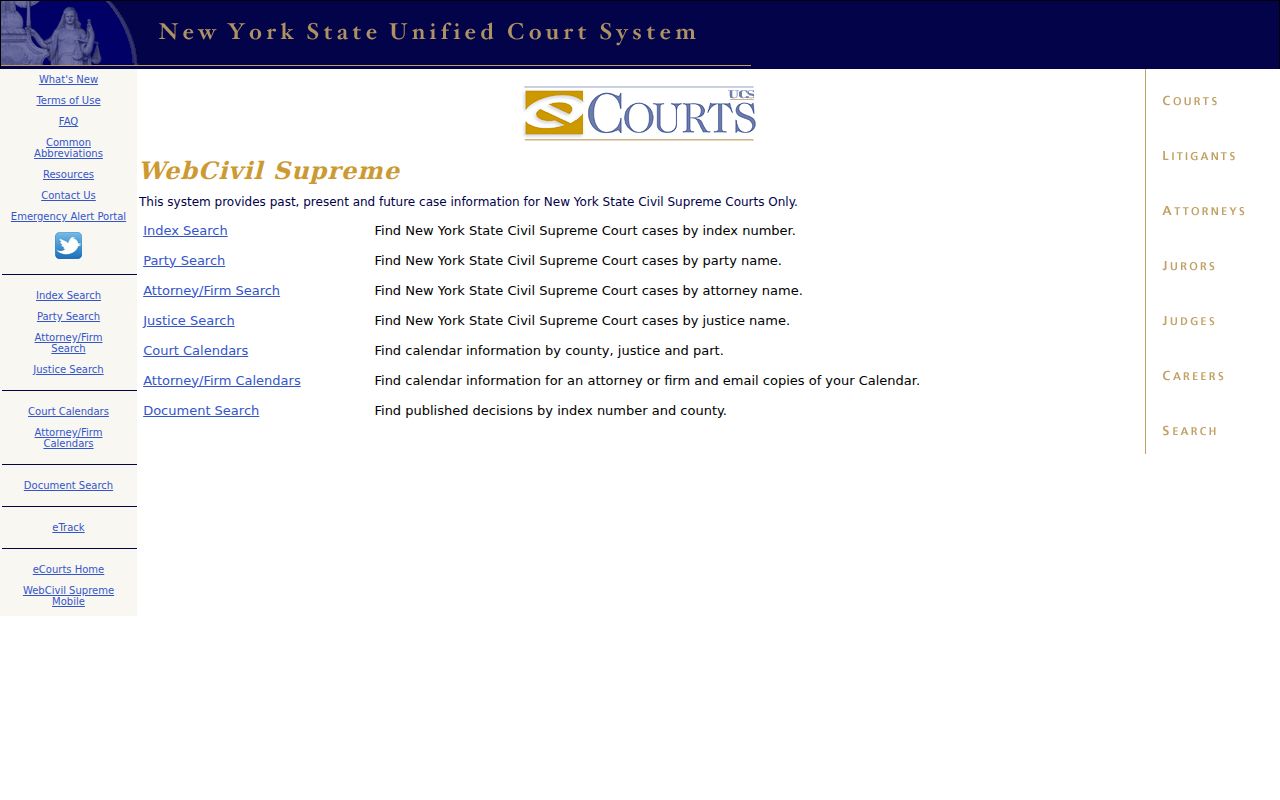
A court result can confirm that a name appeared in a case, but it is not residence proof. WebCivil Supreme is the statewide route for Supreme Court civil cases. Its available tabs include index, party, attorney or firm, justice, calendar, document, and eTrack functions. Narrow a party search by county or court when the portal offers it, then compare party role, filing date, case type, court, and case number before drawing any connection to Nassau County.
The WebCivil search interface below shows the separate public search modes. Results can expose a case or index number, party names and roles, filing date, case type, county or court, justice, calendar information, and document links when they are available.
Older or fuller files may require the clerk’s public terminal or records room, and a certified copy is obtained from the court custodian when legal proof is required. Nassau Surrogate’s Court makes an especially important distinction: its online WebSurrogate window begins February 19, 2014, while earlier records are searched on courthouse public computers.
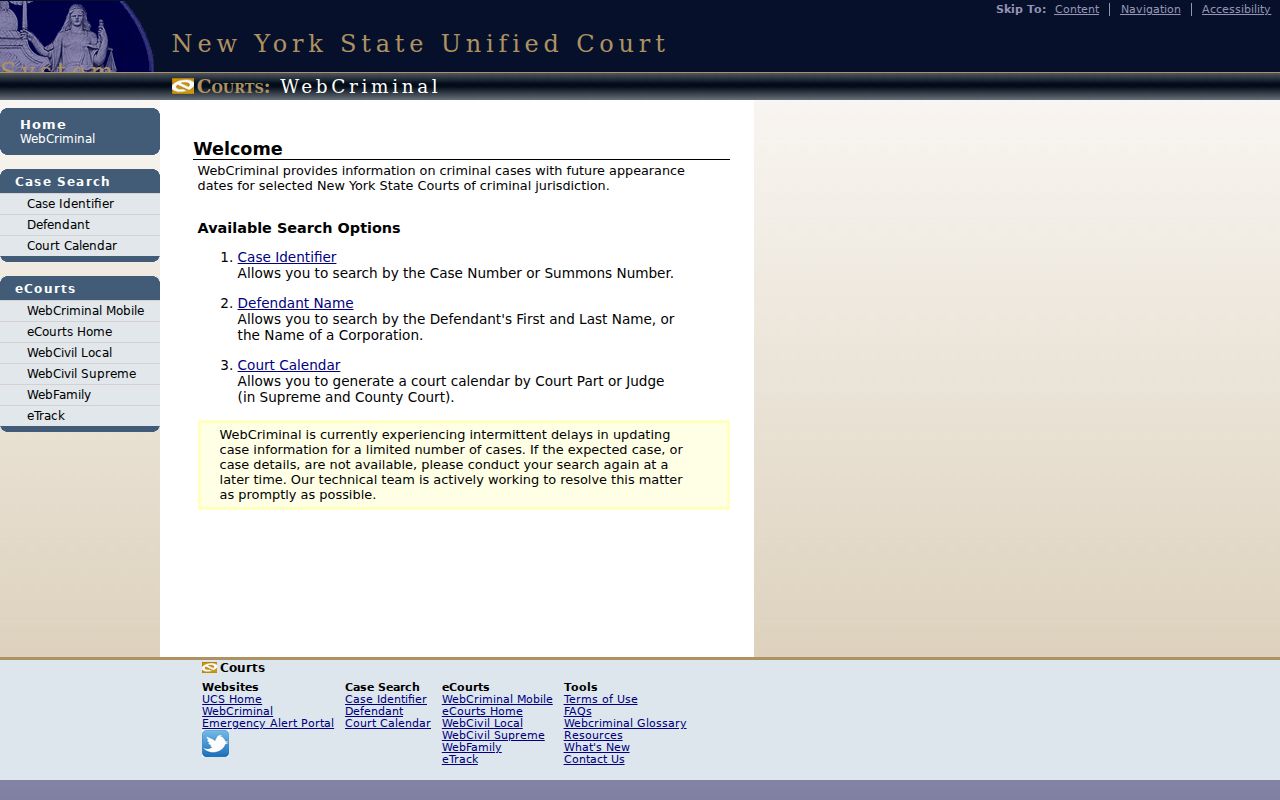
WebCriminal is a separate criminal calendar and future-appearance route for participating courts. It should not be treated as a complete history, and a case match still needs identity confirmation from lawful, independently sourced facts.
Sealed, juvenile, adoption, protected family, and other restricted proceedings are not fully exposed by public systems. A missing online case can mean that the record is restricted, held by another court, or located offline.
| Party identity | Name as filed and party role, such as plaintiff, petitioner, defendant, or respondent. |
|---|---|
| Case placement | Case or index number, court, county, and justice where supplied. |
| Case context | Case category, filing date, status, disposition, or calendar event when displayed. |
| Documents | Links may be unavailable, sealed, or obtainable only through the clerk. |
Nassau County Voter Lookup Limits
The New York State Voter Registration Eligibility Lookup is an identity-match tool, not a public Nassau County resident directory. It asks for last name, first name, date of birth, county, ZIP, and address information, and requires normal JavaScript and cookie operation. Use it only for its authorized registration and election purpose. Do not publish a birth date, protected address, or a failed-match inference.
New York Election Law §3-103(5) restricts voter information to election purposes. The State Board says a written voter-file request must state the election purpose, the county or district, date range, contact information, and requested format. Nassau’s Board of Elections is at 240 Old Country Road, fifth floor, Mineola, and can be reached at 516-571-VOTE (8683) or 516-571-2411. The public portal has no countywide browse-by-street function.
Inactive status, a spelling difference, an address update, or confidentiality can all affect a match. Neither ballot choices nor a general public list of protected voter addresses is available. A failed lookup is not permission to try relatives, parcel records, or alternate names to work around a protected omission.
Verify a Nassau County Resident Lookup
For one-person research, use a short, repeatable Nassau County resident lookup sequence. Start with the name and known address or date, anchor it to a record that identifies the correct municipality or parcel, then add a second source that answers a different question. Stop if the records conflict or point to a confidential address. The custodian can explain a record’s coverage, request method, and correction process better than a search result can.
- Record the original name, variants, known address, municipality, and the date the fact was known.
- Use the assessment viewer to capture the parcel’s SBL, situs address, and relevant recorded-owner context.
- Check the Clerk index for a dated instrument and compare its party, legal description, and recording details.
- Use court, voter, license, vital, obituary, or directory material only for the narrow fact each source supports.
- Order or request a custodian copy when a certified document or fuller file is necessary.
- Docket
- A court’s running case record, usually organized around a case or index number and its filings, events, and parties.
- Index versus image
- An index points to a record. An image is a scan of the underlying document and can have separate access or copy rules.
- Certified copy
- An official copy issued by the custodian. It is different from a portal result or an informal printout.
Do not label a person a current resident unless the records actually support that conclusion. “Recorded owner as of instrument date,” “party in a public case,” and “historical directory entry” are more precise descriptions.
Nassau County Resident Record Paths
Vital records answer event questions, not a general current-address question. Nassau County routes birth, death, and marriage certificates by town or city registrar, while New York State Vital Records handles eligible statewide routes for events outside New York City. A familiar postal community may fall under a different town, city, or village registrar, so confirm the municipality before making a request.
Genealogy copies follow different rules from certified copies. NYSDOH lists general opening periods of 75 years for births and 50 years for deaths and marriages, with the marriage request generally requiring both spouses to be known deceased. Direct-line descendants can sometimes qualify earlier with proof of relationship and death. The state reports searches beginning at $22 for one to three years, with added charges for broader ranges, and reports processing of eight months or longer. Certificates remain subject to relationship, identification, and court-order rules.
For an heir or estate question, use Nassau Surrogate’s Court and WebSurrogate where its coverage applies, then request the file or certified copy from the custodian. A probate address may be old or belong to a fiduciary, so compare it with a dated instrument or other independent record before making a person-level conclusion.
Nassau County Reconnection Records
Historical reconnection works best through consent-respecting collections. For a former classmate, check yearbooks, alumni collections, local libraries, and period newspapers for a name, class year, activity, hometown, or public notice from the time. Nassau County libraries, Hofstra’s Long Island Studies Institute, the Historical Society, and the State Library preserve material that may fill a historical gap without presenting it as a current contact record.
For a birth-parent question, use the authorized New York State Department of Health Adoption Information Registry and confidential process rather than public matching. For an older household, combine census, directory, obituary, and Surrogate’s Court evidence. Each route has its own access and privacy rules, and a personal history question does not override them.
Note: A historical connection can help identify the next official custodian, but private current-contact information should remain private unless the person chooses to share it.
Nassau County Official Lookup Fallbacks
When a Nassau County resident lookup ends at an online index, request an existing record from the office that holds it. New York’s Freedom of Information Law, Public Officers Law Article 6 §§84-90, allows requests for existing agency records. A request should reasonably describe the record, date range, address or parcel, and preferred format. Nassau’s records-request route and fee guidance provide the county channel. Agencies do not have to create a new database or answer an open-ended research question.
The state FOIL framework calls for an acknowledgment or response within five business days, with a grant, denial, or approximate determination date. Nassau lists $0.25 per standard black-and-white page, while special media, maps, certificates, or reproduction work can follow an office-specific schedule. A denial should state the reason and appeal route. Agencies may redact private information, law-enforcement material, sealed records, and other exempt content.
Use the County Clerk counter for land and historic index questions, the court clerk for fuller or older files, the town or city registrar for local vital records, the Board of Elections for election information, and libraries or archives for print and microfilm. Keep the request, response date, record number, and redaction reason in the evidence log.
Legal Limits on Nassau County Resident Lookup
A Nassau County resident lookup has firm privacy boundaries. New York’s Address Confidentiality Program gives qualifying survivors and certain reproductive-health participants a substitute mailing address, while the actual address remains confidential under Executive Law §108 and related rules. Confidential voter registration can also withhold an eligible address. DMV personal information is restricted by the federal Driver’s Privacy Protection Act, and vital, adoption, sealed court, and protected records have separate limits.
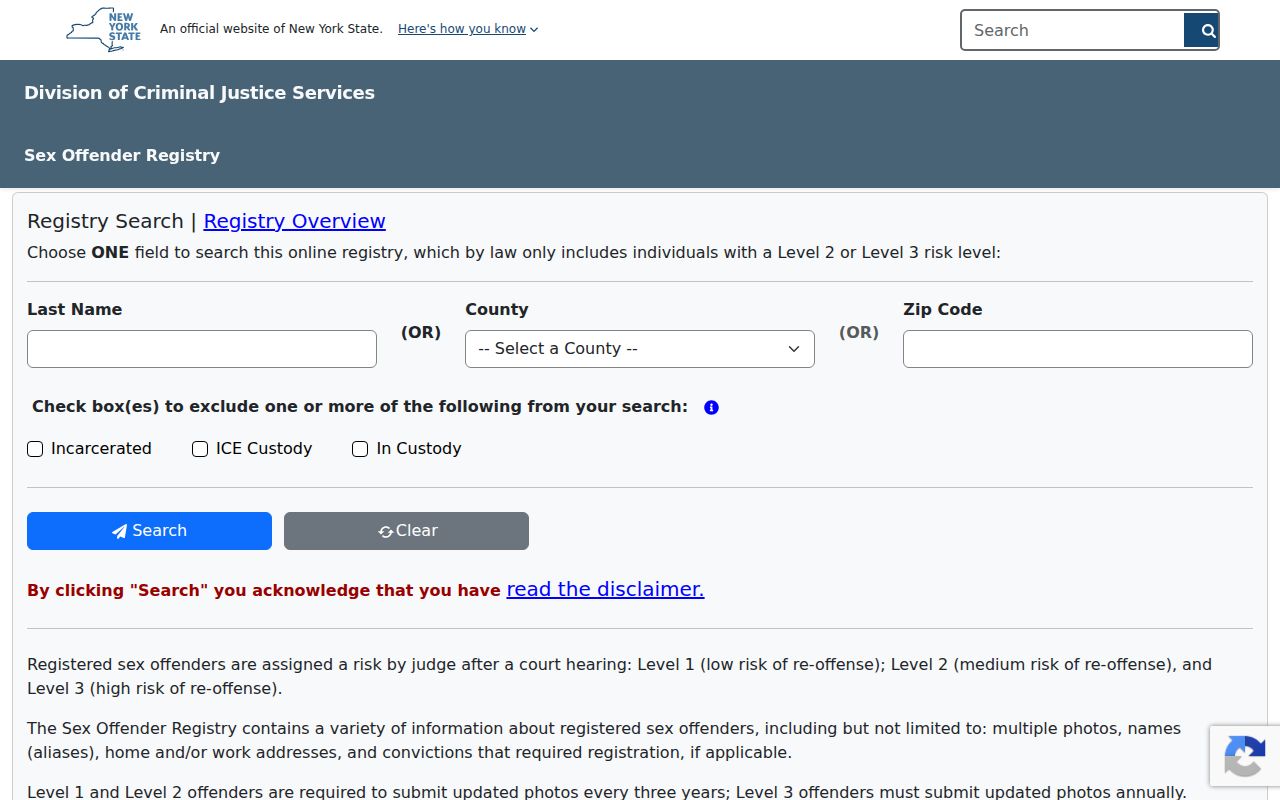
The New York State Sex Offender Registry is a specialized statutory search, not a general resident tool. Its public interface allows one search mode at a time, last name, county, or ZIP, and uses a CAPTCHA. Online profiles cover Level 2 and Level 3 registrants; Level 1 information is provided by telephone with qualifying matching information. The registry warns against harassment and misuse.
Registry information is status-specific and does not prove an unrelated address, household relationship, or a person’s complete history. A public record that reveals a sensitive fact must not be used to target, contact, intimidate, or harass anyone.
Lawful use. Use Nassau County records for personal, lawful research and stop at confidentiality boundaries. New York Penal Law §§120.45 and 240.26 address stalking and harassment, and protected-address omissions must never be reverse engineered.